/Bloomfield%20Shield%20Logo.svg "Bloomfield Shield Logo.svg")
/Bloomfield%20Small%20Logo.svg "Bloomfield Small Logo.svg")
 Archaeological Conservation is an intimidating field for a student from a liberal arts college. Some common prerequisites in pursuing this type of work include: ancient history, advanced ceramics, early Egyptian art, and of course, a great amount of archaeology. In academia today, this field might soon be limited to the students from public institutions who intend to research and eventually compose Ph.D. dissertations. In other words, society has become too specialized for a student studying chemistry to have any hope in a career outside atoms and the periodic table.
Outside of a few examples, much of higher education is filled with students who unknowingly give up much of their academic freedom when they decide to choose a major. They stop becoming students, and start becoming “economics majors” or “pre-med majors” or, in my case, “chemistry majors.” This past semester, I found myself scrambling in a seemingly desperate situation to fit into this “chemistry-major-mold.” I felt an enormous burden to follow the chemistry career flow-chart in finding a competitive internship all the way down to applying for grad school.
I have to admit, I am not a fan of the chemistry career flow-chart. Frankly, I enjoyed studying for my art history exams far more than I did trying to convince others that my chemistry resume was anything better than mediocre. In art history, I was learning about God’s revealed beauty in creation, and man’s ability to discover and depict just a slice of His glory. I loved every minute of the class and would spend hours of my free time in the library reading books on Cezanne, Manet, and Vermeer. I threw the nauseating task of career-planning to the side, and decided to enjoy my semester through my studies. Whatever my future career might look like, I was at college to learn, not to convince future employers that I was a “dedicated, highly-skilled, and research-equipped” student studying chemistry.
I can remember the conversations I had with my professor about my love of studying art. I knew that art appreciation is a discipline of leisure, and that finding a career in art history was not necessarily what I wanted to do. I was sure this passion would not intersect with my major, until he introduced me to the field of art conservation. To provide a definition, art conservation is the practice of conserving the beauty of art and heritage of the past into the present. To my surprise, this was a field which had prerequisites in three main categories: art history, studio art, and shockingly, chemistry.
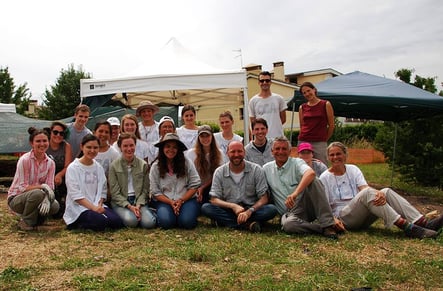 I was even more pleased to find out that Grove City offered a summer program in archaeological conservation in Italy. I thought that if this was a career path I wanted to consider, I needed to go on this trip. I applied, and only a few months later, I was on a plane to Italy. The trip exceeded all of my expectations. I found that excavating and conserving ancient Roman villas was just not for the history major or the archeology major, but for the curious at heart. Having this opportunity for hands-on learning from the best conservators this field has to offer, was nothing short of inspiring. Specifically, I worked with field archeologists and conservators in excavating a 1st century AD Roman villa owned by a friend of Emperor Hadrian. We worked to conserve the villa alongside three floor mosaics, wall frescoes, and marble flooring. After excavation, the team worked on the treatment of fresco fragments in the conservation lab offsite. From initial excavation to treatment, every person had a specific role in each step of the process. Near the end of the trip, we attempted to reconstruct the broken fresco fragments which we discovered from excavation only days earlier. Taking part in this process allowed us to gather a broader picture of the practice of archeological conservation and to better understand the profession. This trip was extremely well-organized in giving us students a realistic, "nuts and bolts" introduction to the work involved in archeological conservation.
After sharing some of my experiences with friends and family, I’ve been asked whether or not this trip has made my career planning any easier. My answer is simple—it hasn’t. Truth be told, I may never have a job in art conservation. From my limited experience, the field is incredible and inspiring, but it can be extremely competitive and very intimidating. I absolutely enjoyed finding the intersection points between my academic training and archeology/art. I continue to be fascinated by this intersection and hope to find more through my pursuit for a job and in life after college. But the truths I learned, the joys I felt, and the beauties that I saw are far more valuable and impactful than anything that a career application could provide. Thankfully, these are joys, beauties, and truths found in all of creation. And this was the most valuable lesson from the trip: that our world is filled with intersections of disciplines which reflect the glories of the Divine.
 As I am preparing for life beyond college, the biggest temptation I have found is in letting my major define my goals, my interests, my career, or even my identity. I am so grateful for classical and liberal arts education which has taught me through countless examples that education is far more important in developing our humanity than it is in preparing our future careers. I am forever indebted to the life-shaping and life-changing lessons of the teachers, professors, and subjects which have challenged me to become a better student and a better person.

/Compressed%20Images/BCS-logo-master-rev%20(2)%20(1).png?width=320&name=BCS-logo-master-rev%20(2)%20(1).png "BCS-logo-master-rev (2) (1).png")